ABC Imagem Cardiovasc. 2026; 39(3): e20260083
Mitral Regurgitation with Multiple Jets: An Integrated and Hierarchical Approach

DOI: 10.36660/abcimg.20260083i
Abstract
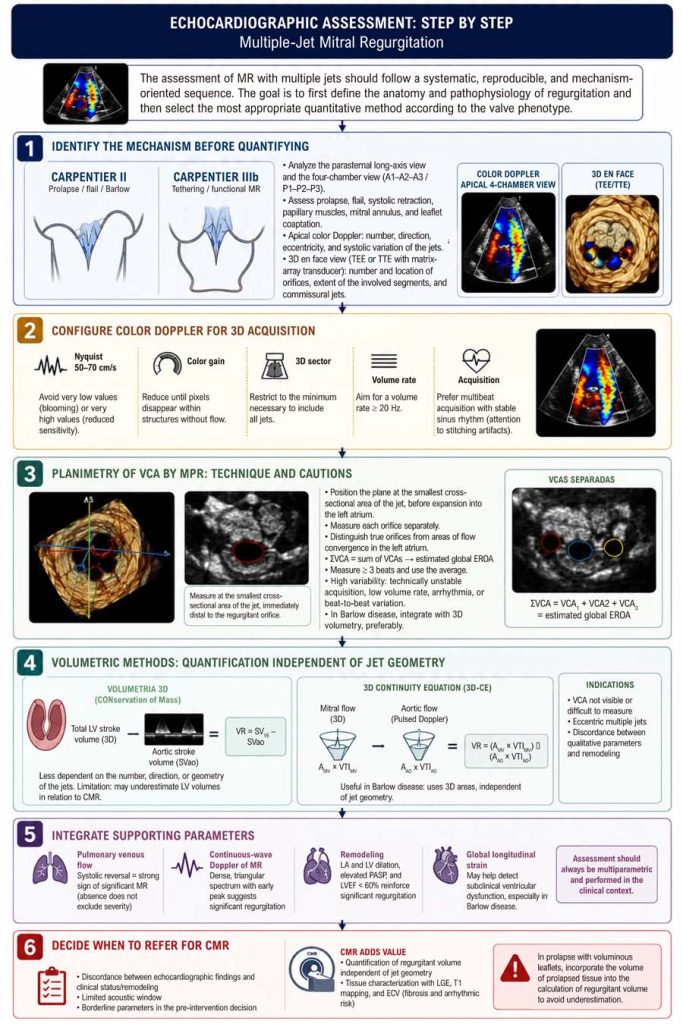
Mitral regurgitation (MR) with multiple jets is a highly complex diagnostic scenario, frequently encountered in Barlow disease and functional phenotypes associated with ventricular remodeling. Conventional two-dimensional methods (e.g., vena contracta width, color jet area, and hemispheric proximal isovelocity surface area) have important limitations in the presence of multiple regurgitant orifices, eccentric jets, the Coanda effect, overlap of flow convergence zones, or noncircular annular geometry, which may lead to underestimation of volume overload. Three-dimensional echocardiography overcomes part of these limitations by enabling en face characterization of the mitral valve, planimetric measurement of the vena contracta area using multiplanar reconstruction, and the application of volumetric methods based on directly measured anatomical areas. The three-dimensional continuity equation (3D-CE), particularly in mitral valve prolapse and Barlow disease, has demonstrated promising agreement with the regurgitant volume measured using cardiac magnetic resonance (CMR); however, the available evidence should still be interpreted in the context of recent studies and patient populations. CMR remains the reference standard for volumetric assessment when echocardiographic findings discord with the clinical presentation, acoustic windows are suboptimal, or pre-interventional decision-making involves borderline parameters. This review proposes a hierarchical, multiparametric, and technically reproducible approach for assessing MR with multiple jets.
6