ABC Imagem Cardiovasc. 2026; 39(3): e20260094
Equity and Representation in Cardiovascular Imaging: A Scientific Imperative, Not an Ideological One

DOI: 10.36660/abcimg.20260094i
Abstract
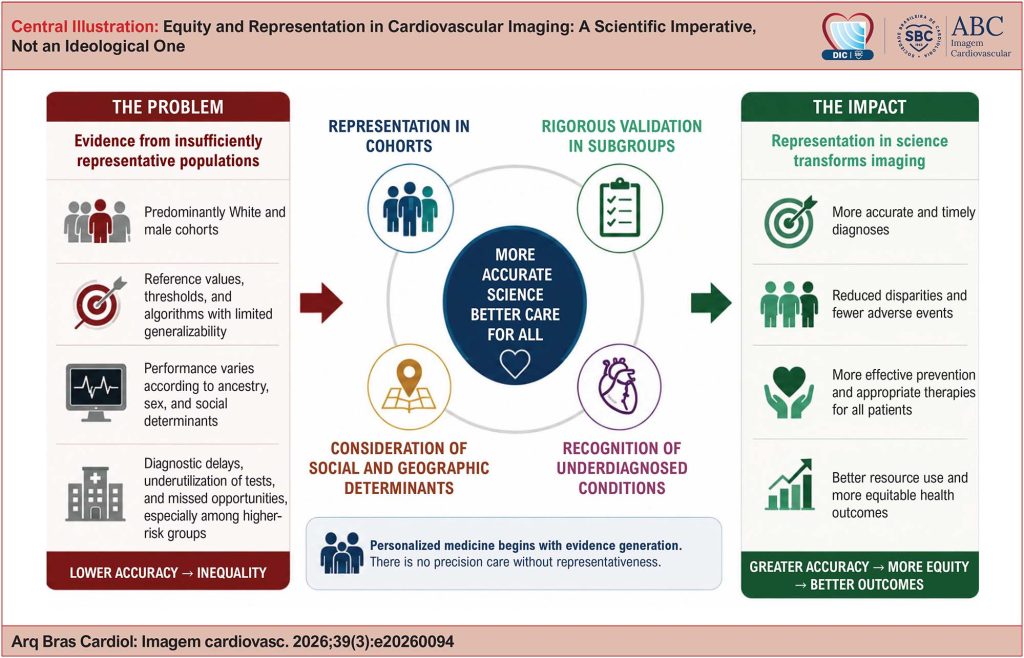
Much of cardiovascular medicine has been built on evidence derived from predominantly White, male cohorts that do not reflect the diversity of the patient population. Consequently, reference values, devices, and algorithms may exhibit variable accuracy across groups, thereby compromising diagnostic precision. From the perspective of cardiovascular imaging, this review examines how underrepresentation in research translates into diagnostic inequities. We discuss scenarios where representation alters what imaging reveals: transthyretin amyloidosis associated with the Val142Ile variant in older adults of African ancestry, cardiopulmonary manifestations of sickle cell disease, and conditions that predominantly affect women, including ischemia with non-obstructive coronary arteries (INOCA) and takotsubo syndrome. We also address bias in devices and algorithms, exemplified by pulse oximetry and artificial intelligence models trained on datasets lacking diversity. Finally, we propose an agenda centered on ensuring representation in normative cohorts, subgroup validation, and the equitable implementation of novel technologies.
Keywords: Algorithms; Bias; Diagnostic imaging; Equity
17