ABC Imagem Cardiovasc. 2026; 39(3): e20260032
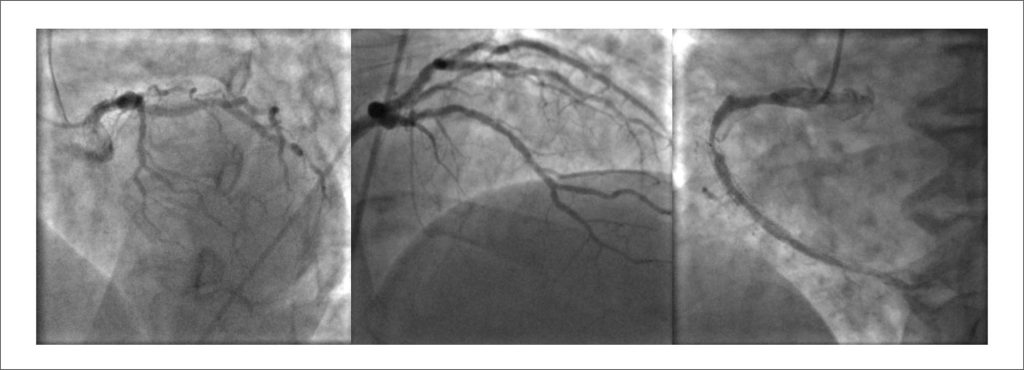
Coronary Artery Disease In A Rare Anatomical Scenario: Type IV Duplicated Left Anterior Descending Artery

DOI: 10.36660/abcimg.20260032i
Introduction
Congenital coronary anomalies comprise a heterogeneous group of anatomical variations, most often identified incidentally during non-invasive imaging studies or invasive diagnostic and therapeutic procedures. Studies show that approximately 1.3% of individuals undergoing coronary angiography present some form of coronary anomaly. Although most are considered benign, certain anomalies may be associated with myocardial ischemia, ventricular arrhythmias, and, in rare cases, sudden cardiac death. It is important to emphasize that coexistence with obstructive coronary artery disease (CAD) may amplify their clinical impact.
Among these variations, duplication of the left anterior descending (LAD) artery stands out due to its rarity and diagnostic relevance. According to the classification proposed by Spindola-Franco et al. (), this anomaly is divided into four types based on the origin and course of the branches. In Type I, the most frequent form, the short and long LAD originate from the bifurcation of the main LAD artery; the short LAD artery follows the anterior interventricular groove and terminates early, whereas the long LAD artery runs parallel along the left ventricular surface before rejoining the distal groove. In Type II, the short and long LAD also arise from the bifurcation of the main LAD artery; however, the long LAD artery courses to the right of the anterior interventricular groove before reaching the apex. In Type III, the long LAD artery has an initial intramyocardial trajectory before emerging distally on the epicardial surface. Finally, in Type IV, the rarest type, a short LAD artery originates from the left coronary artery, while a long LAD artery arises anomalously from the right coronary artery (RCA) or its sinus of Valsalva.² This long branch follows an intraseptal course before emerging in the anterior interventricular groove and reaching the apex, occurring in approximately 0.2% of patients undergoing coronary angiography.
[…]
205