Arq Bras Cardiol: Imagem cardiovasc. 2023; 36(1): e367
Role of Multimodality for the Diagnosis of Thrombosis at Late Follow-up of Patients Selected for TAVI: Review of a Case Series

Introduction
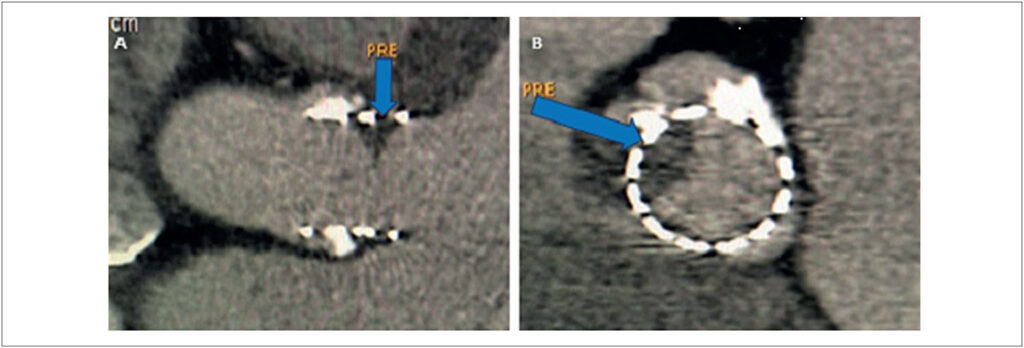
The first transcatheter aortic valve implantation (TAVI) was performed by Alan Cribier in France in 2002 and the technique was introduced in Brazil in 2008. Since then, this modality has been consolidated and many patients have been approached using this technique. After more than 10 years of the first TAVI in Brazil, an increasing number of late complications appear in the cardiovascular imaging laboratory, with challenging anatomical and functional aspects in daily practice. Late thrombosis of aortic endoprosthesis may be one of the causes of dysfunction in the follow-up after TAVI. This clinical entity can assume a complex profile for accurate diagnosis and proper patient management, since it can have a variable presentation, ranging from subclinical leaflet thrombosis to limiting symptoms related to heart failure. Transesophageal echocardiography (TEE), the additional resource of 3D echocardiography and high-resolution computed tomography (CT) play a complementary role in the diagnosis of this etiology through anatomical valve reconstruction with evidence of hypoattenuated leaflet thickening (HALT) with or without hypoattenuation affecting motion (HAM) of one or more prosthetic valve leaflets., The risk of embolic events after diagnosis of leaflet thrombosis is still uncertain, especially for the central nervous system., This case series presents two illustrative reports of aortic endoprostheses with high gradients and complementary aspects of the multimodality that direct the etiology to the diagnosis of late prosthesis thrombosis.
[…]
396