ABC Imagem Cardiovasc. 2026; 39(2): e20260036
Impact of Isometric Exercise on Left Ventricular Mechanics Assessed by Global Longitudinal Strain and Myocardial Work in Healthy Adults

DOI: 10.36660/abcimg.20260036i
This Original Article is referred by the Short Editorial "Myocardial Work During Isometric Exercise: From Physiology to Clinical Practice".
Abstract
Background:
Traditional volumetric parameters have limitations in detecting subtle left ventricular (LV) systolic dysfunction. Global longitudinal strain (GLS) and myocardial work (MW) allow a more sensitive assessment of ventricular mechanics.
Objectives:
To evaluate changes in GLS and MW indices during isometric handgrip exercise compared with resting conditions.
Methods:
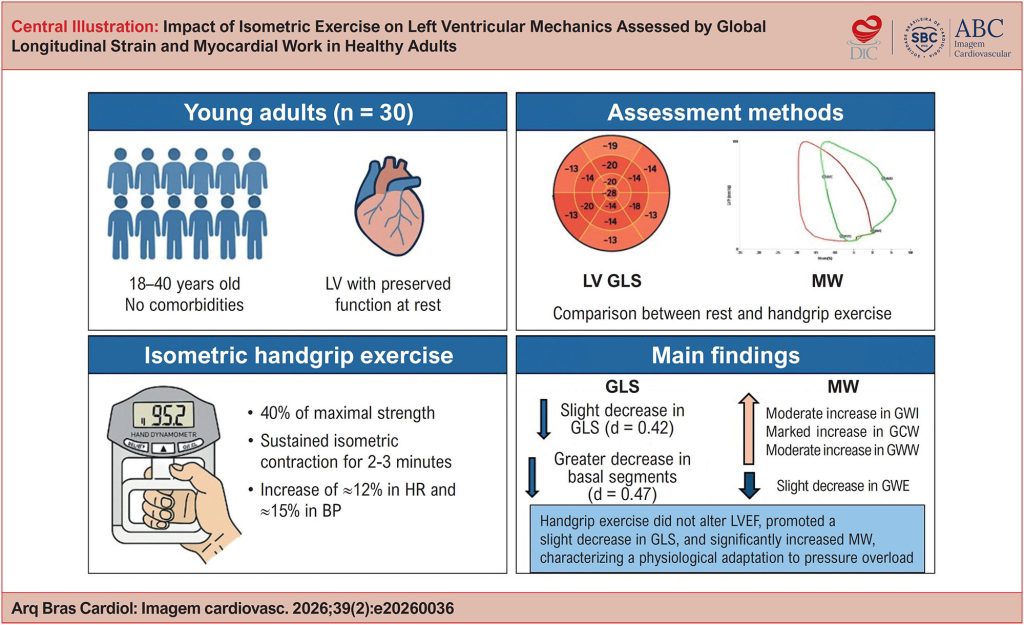
A total of 30 healthy individuals (29.3 ± 6.1 years; 50% male) were included in the sample. Echocardiography was performed at rest and during handgrip exercise (30%-40% of maximal strength). GLS, LV ejection fraction (LVEF), and MW indices were assessed: i) global work index (GWI), ii) global constructive work (GCW), iii) global wasted work (GWW), and iv) global work efficiency (GWE). Comparisons were performed using paired tests. Statistical significance was set at p < 0.05.
Results:
Handgrip exercise increased both systolic blood pressure (115 ± 16 vs 133 ± 18 mmHg; p < 0.0001) and diastolic blood pressure (69 ± 9 vs 79 ± 13 mmHg; p = 0.0002), without significant changes in LVEF (64.8% vs 64.4%; p = 0.62). A decrease in GLS was observed (20.38% ± 2.57% vs 19.60% ± 2.52%; p = 0.028), along with increases in GWI (+244 mmHg%; p = 0.0002), GCW (+313 mmHg%; p < 0.0001), and GWW (+52 mmHg%; p = 0.0008) as well as a decrease in GWE (94.8% ± 1.8% vs 93.6% ± 2.5%; p = 0.022).
Conclusions:
Handgrip exercise induces measurable ventricular mechanical changes in healthy individuals, reflecting a physiological response to acute pressure overload.
Keywords: Echocardiography; Exercise; Left Ventricular Dysfunction
1,070