ABC Imagem Cardiovasc. 2026; 39(1): e20260018
Correlation Between Venous Excess Ultrasound and N-Terminal Pro-B-Type Natriuretic Peptide Levels in Patients With Acute Decompensated Heart Failure

DOI: 10.36660/abcimg.20260018i
This Original Article is referred by the Short Editorial "Phenotyping of Congestion in Decompensated Heart Failure: Life-Saving Accuracy".
Abstract
Background:
The Venous Excess Ultrasound (VExUS) score has been proposed as an ultrasonographic method for assessing systemic venous congestion in patients with acute decompensated heart failure (ADHF). However, the relationship between VExUS and the biomarker N-terminal pro-B-type natriuretic peptide (NT-proBNP) remains unclear in literature.
Objectives:
To evaluate the correlation between the VExUS score and serum NT-proBNP levels in patients with ADHF.
Methods:
This retrospective observational study included 117 patients hospitalized with ADHF. Systemic venous congestion was assessed using the VExUS score, and serum NT-proBNP levels were obtained from laboratory records. Comparisons between groups were performed using the Kruskal-Wallis test, followed by Dunn’s test for multiple comparisons. The strength of association between variables was analyzed using Spearman’s correlation coefficient.
Results:
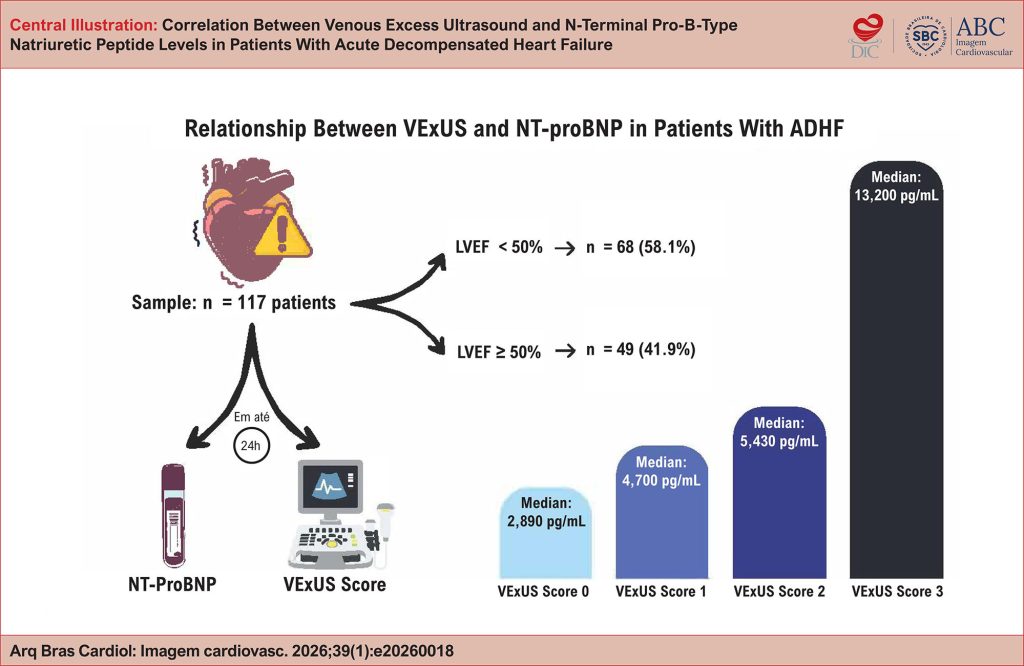
NT-proBNP levels increased progressively with increasing VExUS severity, with median values of 2,890 pg/mL (VExUS 0), 4,700 pg/mL (VExUS 1), 5,430 pg/mL (VExUS 2), and 13,200 pg/mL (VExUS 3). Statistical analysis demonstrated a significant difference between groups (Kruskal-Wallis: χ2 = 39.18; p < 0.0001). Dunn’s test indicated that patients with VExUS 3 had significantly higher NT-proBNP levels compared with the other groups (p < 0.01). A moderate positive correlation was observed between the variables (Spearman’s coefficient ρ = 0.567; p < 0.0001).
Conclusion:
The results indicate that the VExUS score is associated with NT-proBNP levels and may be integrated into clinical reasoning when assessing venous congestion in patients with ADHF.
Keywords: Heart failure; Inpatients; Ultrasonics
554