Arq Bras Cardiol: Imagem cardiovasc. 2023; 36(3): e20230069
Diagnostic Accuracy of the Coronary Calcium Score Acquired with Reduced Radiation Dose and Iterative Reconstruction

DOI: 10.36660/abcimg.20230069i
Abstract
Background:
The calcium score is an imaging test used to evaluate cardiovascular risk by detecting coronary artery calcification (CAC). However, exposure to ionizing radiation during computed tomography (CT) has been a concern.
Objective:
The objective of this study was to evaluate radiation dose and the diagnostic quality of the calcium score using reduced tube voltage and iterative image reconstruction.
Methods:
This was a cross-sectional, observational study with patients over 18 years of age. Patients with previous coronary artery disease and patients who declined to participate were excluded. We acquired calcium score twice (120 kV and 100 kV) with different iterative reconstruction techniques. Two professionals interpreted the exams.
Results:
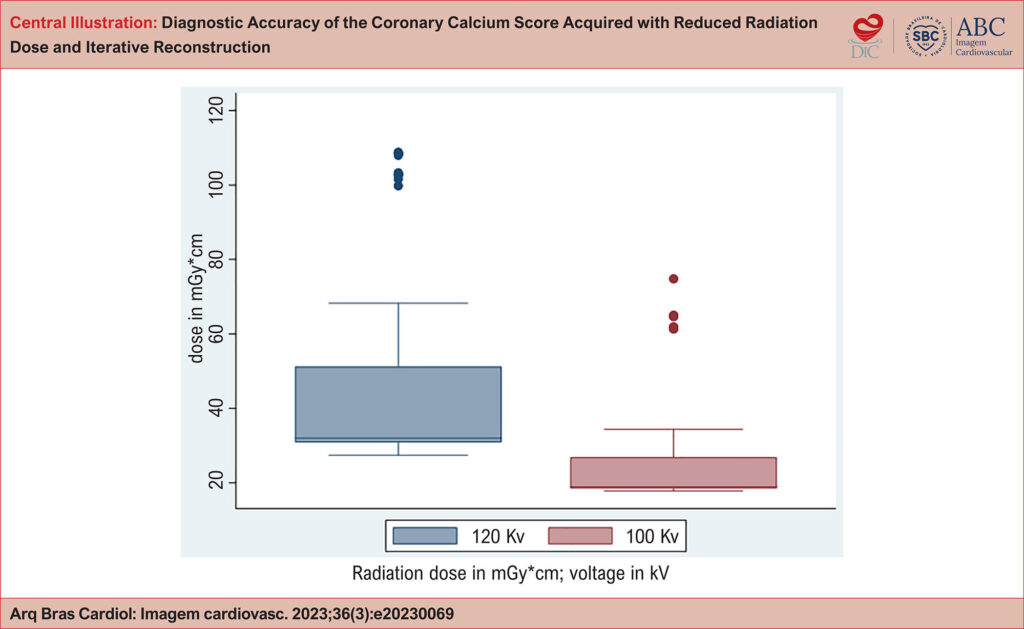
We evaluated 153 patients, and the reduction in radiation dose between acquisitions with 120 kV and 100 kV was 43%. The agreement of the degree of CAC between the different acquisitions was high, ranging from 93.9% to 96.2%. In Bland-Altman analysis, we observed a slight overestimation of the results in the acquisition with 100 kV compared to the acquisition with 120 kV.
Conclusion:
Calcium score acquired at 100 kV using Iterative Model Reconstruction (IMR) iterative reconstruction resulted in a significant reduction in radiation dose. Furthermore, agreement with acquisition at 120 kV was high, indicating that this approach may be a viable alternative to decrease radiation exposure during calcium score testing. However, it is important to underscore the slight overestimation of the results in the acquisition with 100 kV, which must be considered in the clinical interpretation.
565