Arq Bras Cardiol: Imagem cardiovasc. 2021; 34(3): eabc173
Myocardial Deformation (Strain) and Myocardial Fibrosis in Mild Cardiac Chagas Disease
DOI: 10.47593/2675-312X/20213403eabc173
Abstract
Background:
The early identification of myocardial damage seems important in the management of patients with Chagas disease. However, it is unknown whether speckle tracking echocardiography strain and cardiac magnetic resonance imaging are promising methods for assessing myocardial involvement and fibrosis, respectively.
Objective:
To evaluate myocardial involvement in the mild chronic cardiac form of Chagas disease using speckle tracking strain and myocardial fibrosis by cardiac magnetic resonance and assess their correlations.
Method:
This cross-sectional study analyzed patients with the mild chronic cardiac form of Chagas disease (preserved ejection fraction) using speckle tracking echocardiography and cardiac magnetic resonance.
Results:
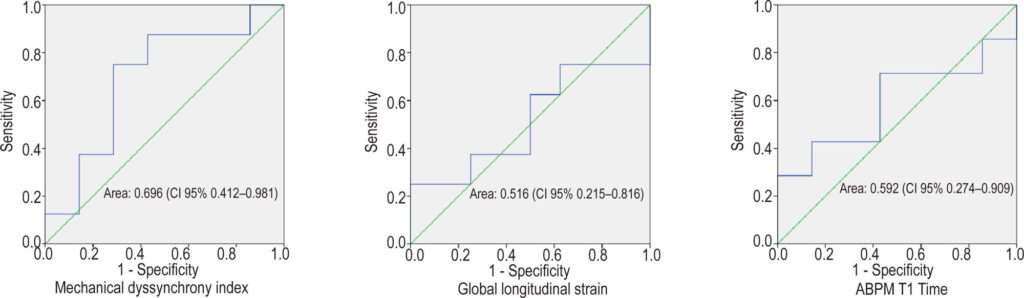
The study included 21 participants (women: 62%; age: 54 ± 5 years). The prevalence of myocardial fibrosis was 50% on delayed myocardial enhancement. The median global longitudinal strain was decreased (14.1%; interquartile range, 12.1–16.3%) in 17 patients (81%). The mean T1 mapping value was high in patients with Chagas disease (993 ± 163 ms). The T1 map was significantly correlated with the global longitudinal strain (r = 0.634; p = 0.015). In addition, the mechanical dispersion index obtained by strain was increased (>55 ms) by 84%, with the largest area under the receiver operating characteristic curve (area under the curve, 0.696; 95% confidence interval, 0.412–0.981) for fibrosis discrimination by delayed myocardial enhancement.
Conclusion:
Myocardial strain and T1 mapping are early markers of myocardial damage in mild chronic Chagas heart disease. The mechanical dispersion index was high and the most closely correlated with delayed myocardial enhancement.
238