Arq Bras Cardiol: Imagem cardiovasc. 2025; 38(2): e20250023
My Approach to Point-of-Care Ultrasound for Dyspnea Assessment

DOI: 10.36660/abcimg.20250023i
Abstract
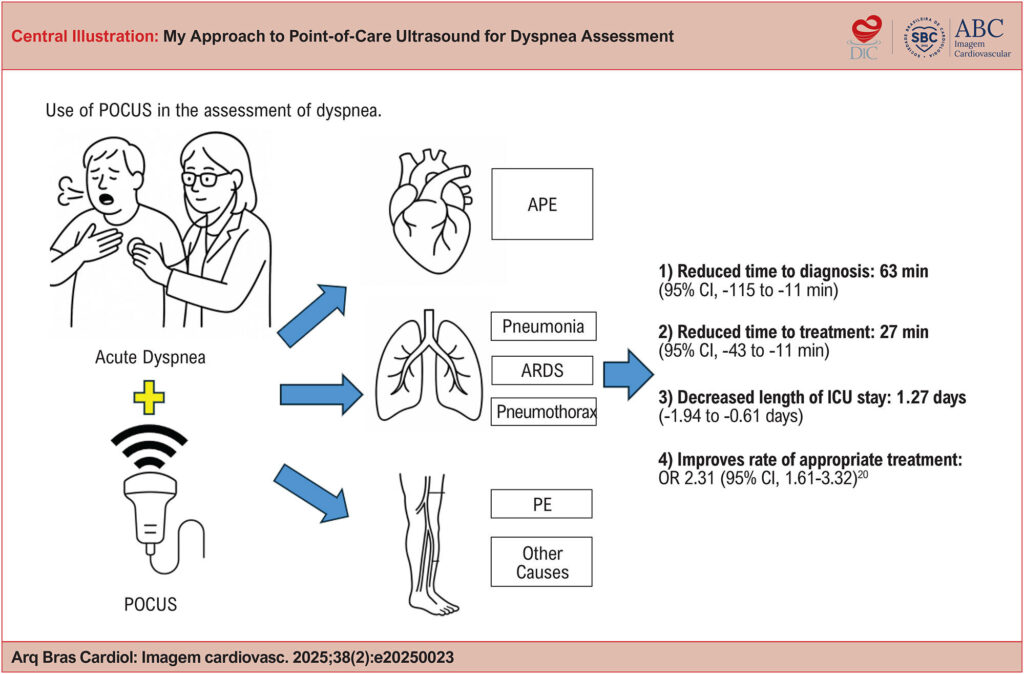
Dyspnea is a common and potentially serious symptom whose traditional diagnostic approach, based on physical examination and complementary tests, may present significant limitations. Point-of-care ultrasound (POCUS) has emerged as an effective tool for the rapid and accurate assessment of this symptom, both in outpatient settings and in emergency and critical care environments.
This article provides a practical, illustrated guide to the integrated application of POCUS in the evaluation of dyspnea, with an emphasis on distinguishing cardiac from pulmonary causes. It describes techniques for acquiring cardiac, pulmonary, and venous ultrasound images, highlights key sonographic findings, and outlines a step-by-step approach to clinical application. Lung POCUS has demonstrated high sensitivity in detecting differential diagnoses of dyspnea. Its integration with echocardiography and lower limb ultrasound further refines diagnosis by identifying specific clinical patterns such as acute pulmonary edema (APE), pulmonary embolism (PE), and acute respiratory distress syndrome (ARDS).
The structured use of POCUS represents a significant advancement in the modern physical exam, enabling faster and more accurate bedside clinical decision-making. Its adoption should be encouraged among cardiologists, intensivists, and healthcare professionals working in critical care settings.
Keywords: Dyspnea; Echocardiography; Ultrasonography
1,078