Arq Bras Cardiol: Imagem cardiovasc. 2024; 37(4): e20240104
Left Ventricular Strain in Heart Failure with Preserved Ejection Fraction: A Fast Dive into Diagnosis, Response to Exercise and Afterload Challenge

DOI: 10.36660/abcimg.20240104i
Abstract
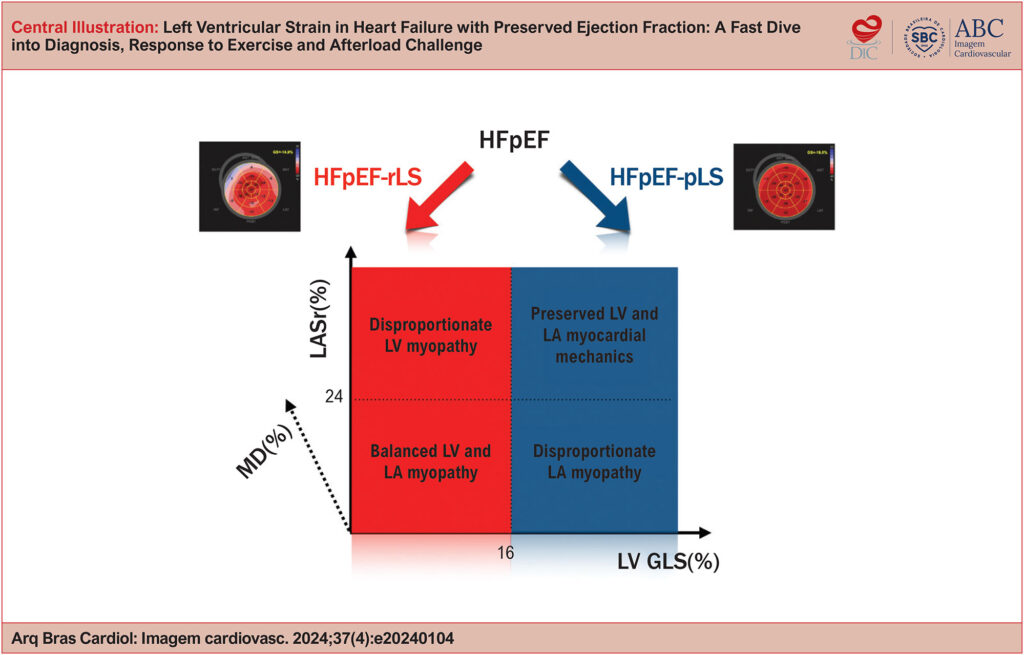
Heart Failure with Preserved Ejection Fraction (HFpEF) is an increasing challenge in cardiology, marked by impairments in systolic and/or diastolic function. HFpEF patients often present with exercise intolerance, yet diagnosis is complicated by overlapping comorbidities, such as obesity and hypertension. Left ventricular Global Longitudinal Strain (GLS) enables the detection of subtle systolic dysfunction, with studies indicating a stronger correlation between GLS and exercise capacity than ejection fraction (EF). In exercise echocardiography, GLS displays a characteristic bimodal pattern due to hemodynamic adaptations, with deviations suggesting HFpEF. When exercise testing is unfeasible or when a specific evaluation of ventricular-arterial coupling is desired, an afterload challenge offers a controlled alternative by increasing systemic resistance. Beyond GLS, mechanical dispersion (MD) measures contractile heterogeneity, while left atrial strain (LAS) has shown promise in identifying atrial dysfunction linked to HFpEF. These parameters, evaluated alongside E/e’ ratios and pulmonary systolic pressure during exercise, enhance HFpEF diagnosis, provide a more comprehensive view of the syndrome’s pathophysiology, and offer insights to support treatment.
Keywords: Echocardiography; Exercise; Heart failure
2,216