Arq Bras Cardiol: Imagem cardiovasc. 2024; 37(4): e20240093
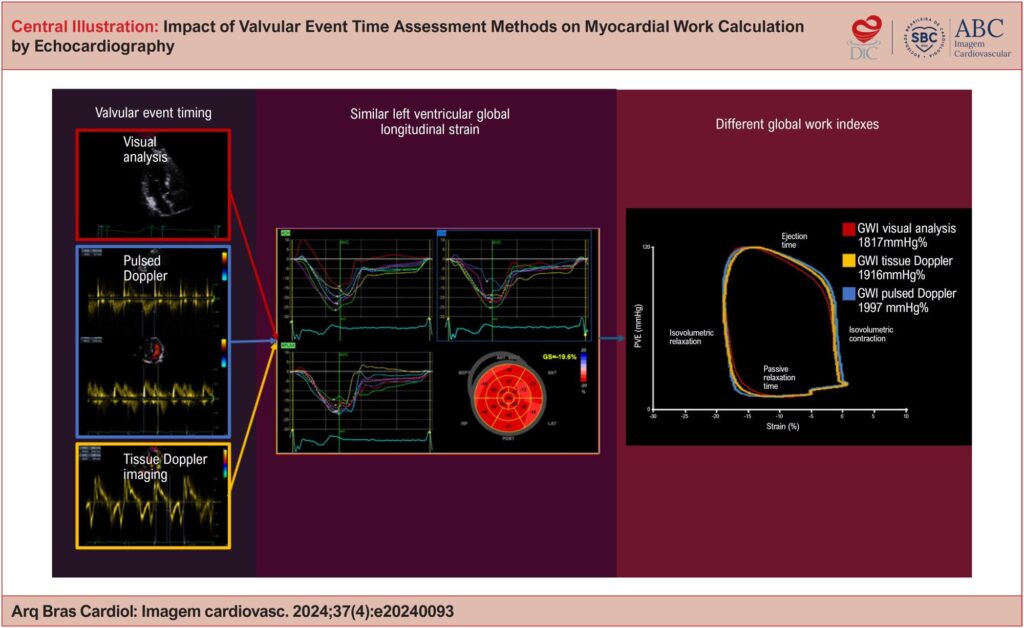
Impact of Valvular Event Time Assessment Methods on Myocardial Work Calculation by Echocardiography

DOI: 10.36660/abcimg.20240093i
Abstract
Background:
Left ventricular ejection fraction (LVEF) is the traditional parameter for assessing cardiac function, but it has limitations in the early detection of dysfunction. Global Longitudinal Strain (GLS) and myocardial work (MW) are promising alternatives, the latter being less influenced by load conditions. The calculation of MW depends on valvular event times (VET), obtained by methods that may generate divergent results.
Objectives:
To compare the impact of different methods of VET measurement – visual analysis (VA), tissue Doppler imaging (TDI) and pulsed Doppler (PD) – on global work index (GWI), global constructive work (GCW), global wasted work (GWW) and global work efficiency (GWE).
Method:
Cross-sectional clinical study with 35 healthy patients who underwent echocardiography between October 2022 and March 2023. MW was assessed using the EchoPAC software, with VET measurement by VA, TDI and DP. The results were analyzed by ANOVA and Friedman tests, followed by post-hoc analyses with a significance level of 5%.
Results:
GWI showed significant variation between the VET measurement methods, being lower by AV compared to TDI and DP (p<0.001). The GCW, GWW and GWE indexes did not demonstrate statistically significant differences between the methods.
Conclusions:
The VET measurement method significantly impacts the GWI, but does not affect the other MW indexes.
434