Arq Bras Cardiol: Imagem cardiovasc. 2025; 38(2): e20240106
Idiopathic Multiple Coronary Artery Aneurysms

DOI: 10.36660/abcimg.20240106i
Case presentation
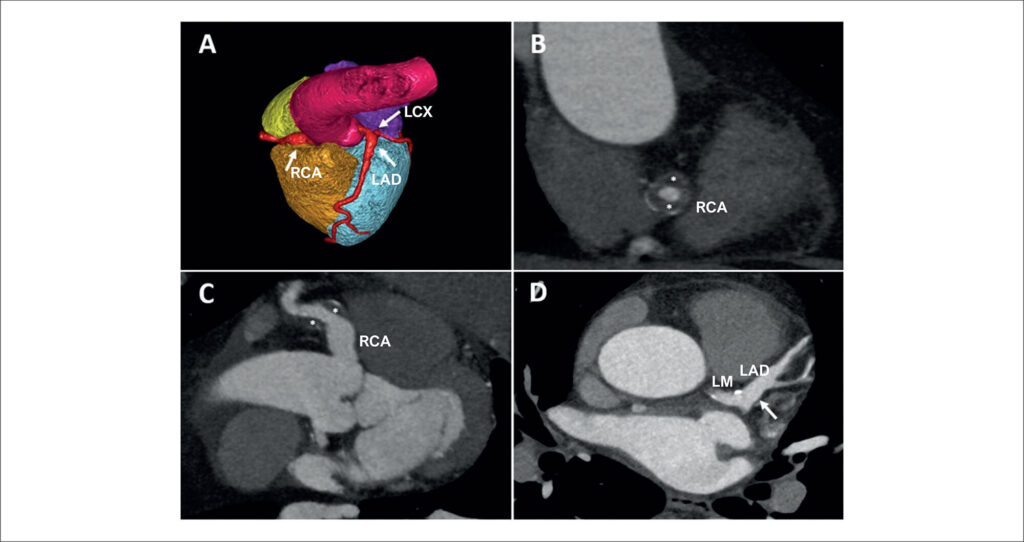
A 54-year-old patient with no previous medical history was evaluated in the cardiology clinic for chest pain with atypical characteristics. Due to a pretest probability of ischemic heart disease of 20%, a coronary computed tomography scan was performed, which showed a coronary aneurysm (10 × 11 mm) from the origin of the right coronary artery (RCA) to the mid-segment (, white arrow; ). In the RCA mid-segment, there was partial circumferential thrombosis with 50% lumen stenosis ( and ; , white asterisks). The rest of the RCA showed no coronary artery obstruction. A 9 × 9 mm aneurysm was also observed in the left main coronary artery extending to the bifurcation and proximal portion of the left anterior descending coronary artery, without significant lesions ( and , white arrows; ). A 5 × 6 mm aneurysm was also observed in the proximal left circumflex artery, without significant coronary lesions (, white arrow; ). The study was completed with a regadenoson stress cardiac magnetic resonance that was negative for inducible ischemia. Serologies and autoantibodies were also requested, and they were negative. The decision was made to initiate medical treatment with acetylsalicylic acid and atorvastatin. During the 6-month follow-up, the patient did not present coronary outcomes and remained asymptomatic.
A coronary artery aneurysm (CAA) is typically defined as a focal dilation of a coronary artery that exceeds 1.5 times the diameter of an adjacent normal segment, whereas coronary ectasia refers to a diffuse dilation involving at least 50% of the artery’s length. Giant coronary aneurysms, although rare, are classified as those measuring more than 20 mm in diameter. This distinction is clinically significant, as ectasia represents a more extensive and generalized involvement of the artery, whereas aneurysms are focal and may carry a different prognosis and management approach.
[…]
Keywords: Case Reports; Coronary Aneurysm
179