Arq Bras Cardiol: Imagem cardiovasc. 2021; 34(1): eabc123
Echocardiographic Evaluation of Patients with Patent Foramen Ovale and Cryptogenic Stroke
DOI: 10.47593/2675-312X/20213401eabc123
Abstract
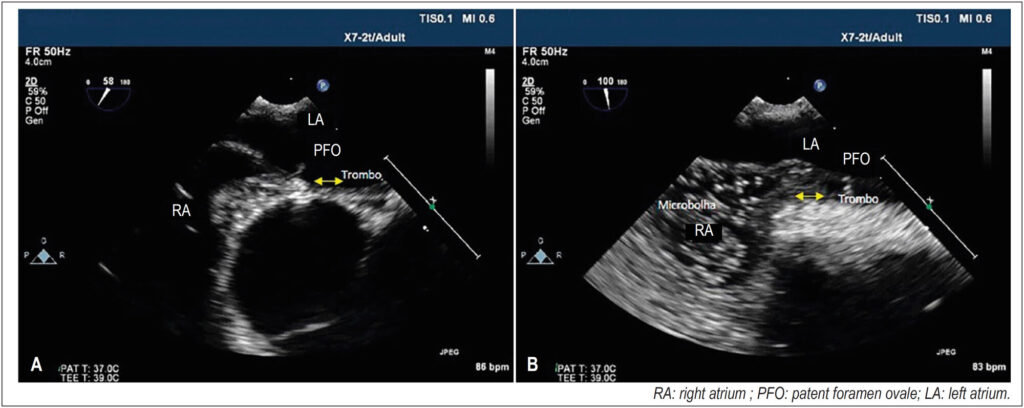
Recent studies have indicated that patent foramen ovale (PFO) may cause cryptogenic stroke in young patients presenting anatomical conditions that can favor it and that transcatheter occlusion reduces the incidence of stroke versus clinical treatment. A transesophageal echocardiographic study with agitated saline injection associated with the Valsalva maneuver can evidence right-to-left shunt with high sensitivity (89%) and specificity (92%). The Risk of Paradoxical Embolism trial evaluated the clinical characteristics of stroke patients with PFO; established a risk score for cryptogenic stroke; and used a multivariate regression model to identify six variables including age, presence of cortical ischemia, diabetes, hypertension, stroke, and previous transient ischemic attack. The highest scores were observed in young stroke patients without vascular risk factors, and the lowest scores were identified in older patients with vascular risk factors in which the PFO appeared to be incidental. Anatomical PFO conditions predispose patients to systemic embolism (PFO separation > 2 mm, PFO tunnel > 10 mm, angle between the inferior vena cava and the PFO flap < 10°, shunt intensity with Valsalva maneuver, and presence of interatrial septal aneurysm and Chiari network or prominent Eustachian valve). PFO closure can prevent paradoxical embolism by decreasing the incidence of stroke in high-risk patients.
Keywords: Echocardiography; Foramen Ovale; Patent; Stroke
705