Arq Bras Cardiol: Imagem cardiovasc. 2025; 38(2): e20250025
Conventional and Partially ECG-Gated Triple Rule-Out Computed Tomography Angiography with Extension to Abdominal Aorta: Comparative Radiation Dose and Imaging Quality

DOI: 10.36660/abcimg.20250025i
This Original Article is referred by the Short Editorial "“Triple Rule-Out”: Including the Abdominal Aorta With a Clear Conscience?".
Abstract
Background:
Triple rule-out (TRO) computed tomography angiography (CTA) is an ECG-gated protocol that enables the simultaneous evaluation of the coronary arteries, thoracic aorta, and pulmonary arteries in a single scan. It is especially useful for patients in the emergency department with low to moderate risk of acute coronary syndrome, particularly when aortic dissection and pulmonary embolism are also considered in the differential diagnosis.
Objective:
This study aimed to compare two TRO protocols, fully electrocardiogram (ECG)-gated (protocol A) and partially ECG-gated (protocol B), both including coverage of the abdominal aorta, in terms of radiation dose and image quality. Such a comparison of protocols can be useful when iterative reconstruction algorithms are not available and a manual transition between partially ECG-synchronized protocols is required.
Methods:
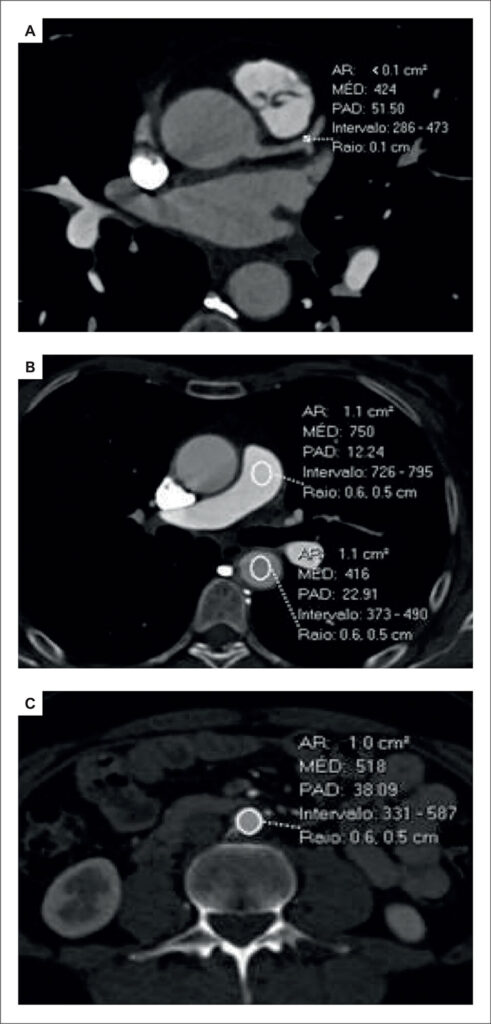
Radiation dose was evaluated using dose-length product (DLP), effective dose (ED), and virtual dose. Attenuation values were measured in the coronary and pulmonary arteries, as well as in the descending and abdominal aorta. Image quality and vessel conspicuity were assessed using a 5-point Likert scale.
Results:
A total of 56 patients were included. Protocol B demonstrated significantly lower radiation exposure compared to protocol A across all metrics: median DLP (1.1 mSv [interquartile range: 0.9 to 1.1] versus 2.2 mSv [interquartile range: 1.6 to 2.8]), ED (17.0 mSv [interquartile range: 14.3 to 18.1] versus 32.6 mSv [interquartile range: 24.4 to 42.7]), and virtual dose (16.2 [interquartile range: 9.3 to 20.4] versus 34.7 [interquartile range: 19.9 to 43.5]); all differences were statistically significant (p < 0.001). There were no significant differences in attenuation measurements or qualitative image assessment between the two protocols.
Conclusion:
Partially ECG-gated TRO CTA provides comparable image quality to the fully ECG-gated technique while significantly reducing radiation exposure, becoming a more radiation dose-efficient alternative when iterative reconstruction algorithms are not available and manual transition is necessary.
249