Arq Bras Cardiol: Imagem cardiovasc. 2025; 38(1): e20240116
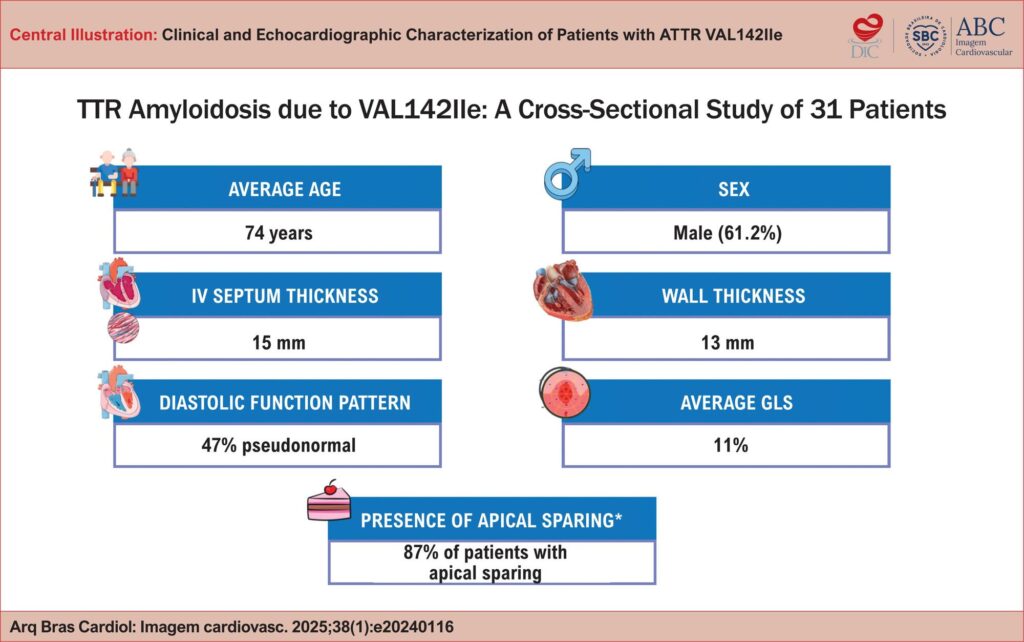
Clinical and Echocardiographic Characterization of Patients with ATTR VAL142IIe

DOI: 10.36660/abcimg.20240116i
Abstract
Background:
Transthyretin (TTR) amyloid cardiomyopathy associated with the VAL142Ile variant typically presents in patients in their sixth or seventh decades of life. It is among the most common hereditary forms of cardiac amyloidosis. This study aims to characterize the clinical, laboratory, and echocardiographic features observed in patients with the VAL142Ile variant, contributing to a deeper understanding of the phenotypic expression of this genetic variant.
Method:
Cross-sectional study of 31 patients diagnosed with HF due to transthyretin amyloidosis (ATTR) VAL142IIe. Functional class, presence of atrial fibrillation (AF) and carpal tunnel syndrome (CTS), and NT-proBNP value were assessed. Diastolic and systolic dimensions, septum, posterior wall (PW), left atrial volume, ejection fraction (EF), diastolic function and global longitudinal strain (GLS) were quantified. Statistical analysis was performed using SPSS software version 26.0.
Results:
Mean age at symptoms onset was 74.3 years (±5.9 years), with 61% being male. A total of 14 (45%) were identified with AF and 17 (55%) with CTS. Regarding New York Heart Association (NYHA) classification, 19 (61%) were in FC II and 8 (25.8%) in FC III. Measurements were diastolic diameter (DD) of 50.6 mm (±8.5), systolic diameter (SD) of 35.2 mm (±7.8), pw = 13.5 mm (±2.1) and ivs = 14.8 mm (±2.4). The left atrial volume was 54.3 mL/m² (±12) and the EF was 47.3% (±15.1). A total of 8 (25%) underwent strain echocardiography, and 7 (87.5%) showed apical sparing. Diastolic dysfunction grade II was observed in 8 (47%), and 14 (45%) had AF. The mean NT-proBNP was 3026 pg/mL (±1941 pg/mL).
Conclusion:
Our findings underscore the importance of characterizing this population, highlighting the potential for early disease onset even with the VAL142Ile variant. Elevated NT-proBNP levels, along with the presence of AF and CTS, further elucidate the phenotypic patterns of patients with the ATTR VAL142Ile variant.
579