ABC Imagem Cardiovasc. 2026; 39(2): e20250102
Concordance Between Echocardiographic Left Ventricular Ejection Fraction by Simpson’s Method, Global Longitudinal Strain, and Cardiac Magnetic Resonance

DOI: 10.36660/abcimg.20250102i
This Original Article is referred by the Short Editorial "Beyond Ejection Fraction: Integrating Myocardial Strain and Cardiac Magnetic Resonance into the Contemporary Assessment of Left Ventricular Function".
Abstract
Background:
Left ventricular ejection fraction (LVEF) measured by echocardiography is a widely used parameter in clinical practice for the assessment of ventricular function. More recently, global longitudinal strain (GLS) has emerged as a complementary method, as has the assessment of LVEF by cardiac magnetic resonance (CMR). However, regional evidence evaluating the concordance among these three techniques remains limited.
Objectives:
To assess the concordance between echocardiographic and CMR measurements in patients treated at a cardiovascular clinic in the city of Cali, Colombia.
Methods:
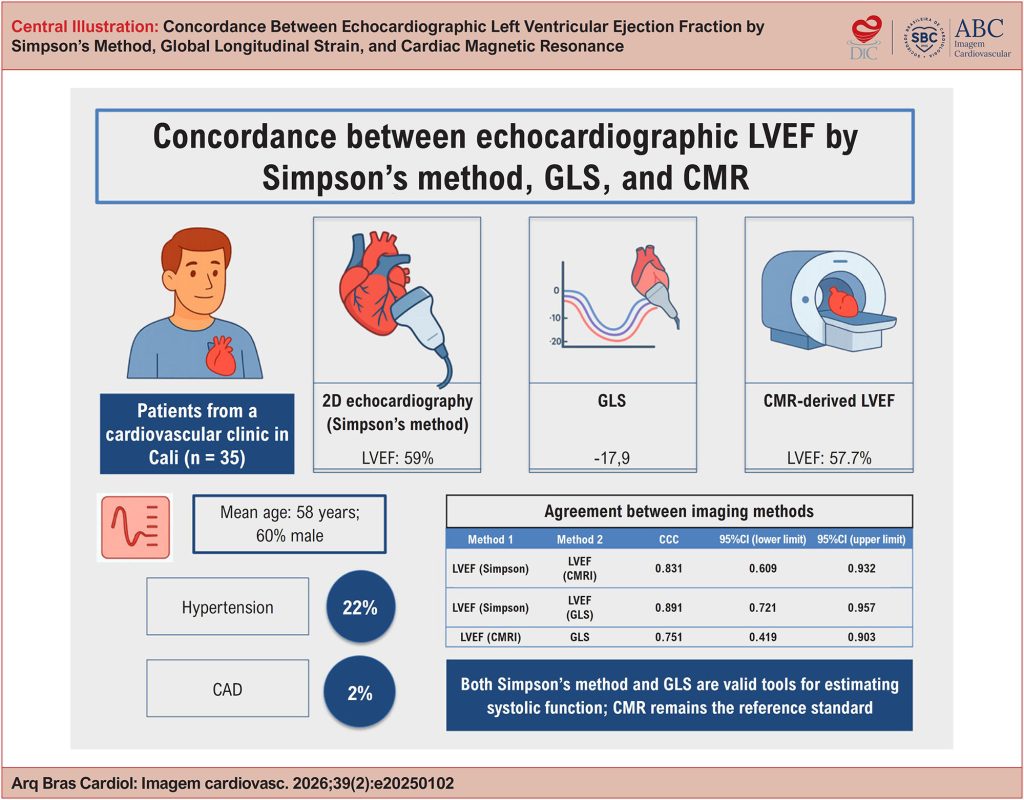
This cross-sectional, analytical, descriptive study included 35 patients with confirmed or suspected heart disease, in whom all three methods were performed consecutively. Concordance was evaluated using Lin’s concordance correlation coefficient (CCC), Bland-Altman plots for LVEF, and linear and quadratic weighted κ coefficients for agreement between LVEF classifications.
Results:
The mean age was 58 years, and 60% of participants were male. The most common comorbidities were hypertension (22%) and dyslipidemia (11%). The mean LVEF was 59% by Simpson’s method and 57.7% by CMR, while the mean GLS was −17.7%. Concordance was as follows: Simpson’s LVEF vs. CMR (CCC, 0.831; 95%CI, 0.609-0.932); GLS vs. CMR-derived LVEF (CCC, 0.751; 95%CI, 0.419-0.903); and Simpson’s LVEF vs. GLS (CCC, 0.891; 95%CI, 0.721-0.957).
Conclusions:
Both Simpson’s method and GLS are valid tools for estimating systolic function. CMR remains the reference standard.
340