ABC Imagem Cardiovasc. 2025; 38(4): e20250103
What Does Myocardial Work Offer Beyond Strain?

DOI: 10.36660/abcimg.20250103i
Introduction
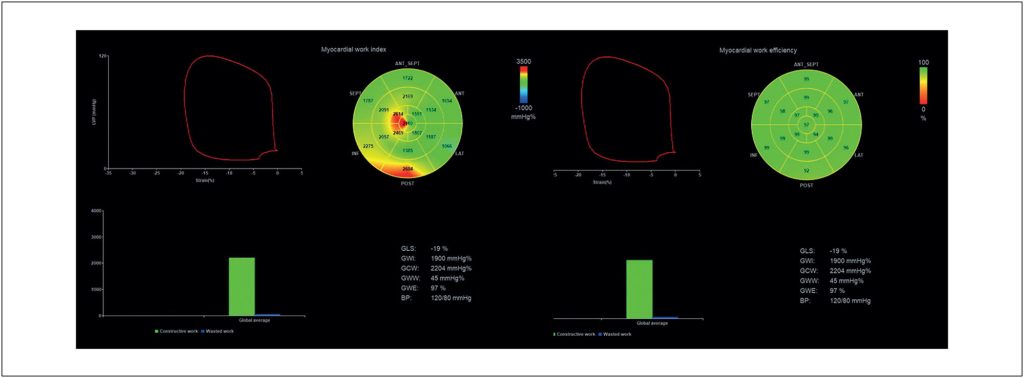
In contemporary cardiovascular imaging, one of the methods that has gained significant relevance by adding diagnostic and prognostic information is speckle-tracking–derived Longitudinal Strain, particularly the assessment of left ventricular Global Longitudinal Strain (GLS). However, although GLS evaluates global myocardial deformation of the left ventricle, it is highly dependent on loading conditions, which may interfere with the accurate interpretation of its results. In this context, an emerging technique has been introduced, also derived from speckle tracking: Myocardial Work (MW). Compared with strain, MW offers the advantage of mitigating afterload bias by incorporating systemic arterial pressure into longitudinal strain analysis, generating Pressure–Strain Loops (PSL) throughout the cardiac cycle. Thus, MW quantifies not only the extent of longitudinal myocardial deformation but also the load under which this deformation occurs, providing refined diagnostic insight into ventricular function. The methodology is based on the work of Russell et al., who validated the PSL area as a noninvasive index of myocardial work and also introduced the concept of wasted work resulting from contractile discoordination. In clinical practice, four global indices are derived: Global Work Index (GWI), Global Constructive Work (GCW), Global Wasted Work (GWW), and Global Work Efficiency (GWE = GCW / [GCW + GWW]) (). shows normal reference values for myocardial work and its indices derived from the Normal Reference Ranges for Echocardiography (NORRE) study of the European Association of Cardiovascular Imaging (EACVI).
[…]
661