Arq Bras Cardiol: Imagem cardiovasc 2025; 38(2): e20240089
Classifying the Size of an Atrial Septal Defect According to Echocardiographic Parameters and its Association with the Clinical Presentation in Pediatrics

DOI: 10.36660/abcimg.20240089i
Abstract
Background
Few studies are using linear echocardiographic measurements for classifying the size of Atrial Septal Defect (ASD).
Objectives
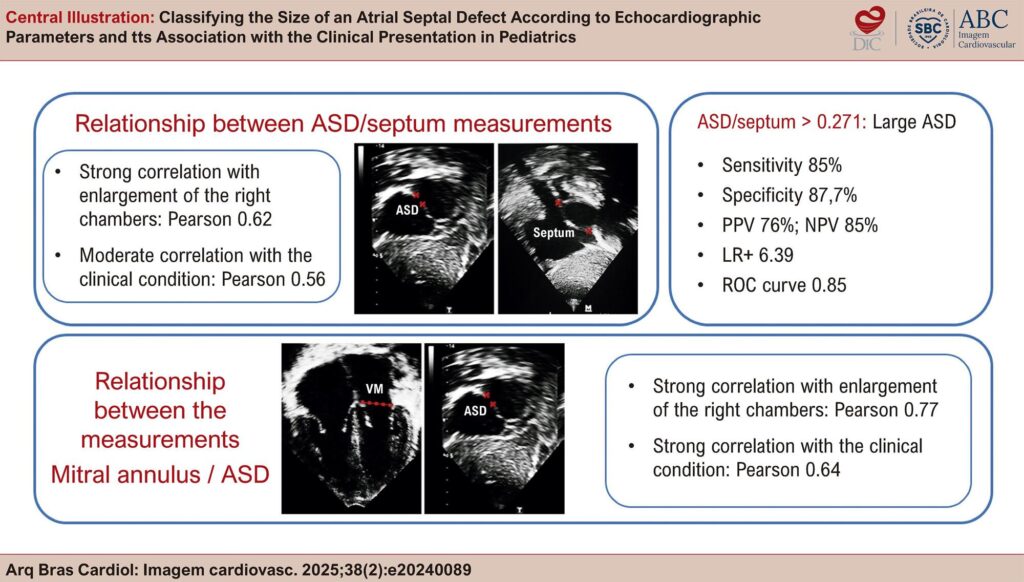
Investigate the relationship between ASD hemodynamic repercussions and ASD diameter to the mitral annulus diameter (MI/ASD) ratio and ASD diameter to the interatrial septum diameter (ASD/septum) ratio, and describe cutoff points to classify the size of the defect.
Methods
An observational, prospective, cross-sectional study, including subjects aged 1 month and 18 years diagnosed with isolated ASD. Hemodynamic repercussion was quantified by clinical evaluation, tricuspid annulus (TA) Z-score, subjective estimation of the enlargement of the right chambers, and the relationship between systemic and pulmonary flows (QP/QS) on echocardiography. Its association with ASD/septum and MI/ASD measurements was also studied. A value of p < 0.05 was considered statistically significant.
Results
Thirty-five subjects, mean age 6.3 years, 69% female, mean ASD 13.5 mm. There was a correlation between MI/ASD and the clinical classification of ASD (Pearson: -0.61; p < 0.001), ASD/septum (Pearson: -0.80; p < 0.001), and QP/QS (-0.76; p < 0.001). There was a correlation between ASD/septum and the clinical classification of ASD (Pearson: 0.56; p < 0.001), QP/QS (0.63; p = 0.001), subjective assessment of the right chambers (0.62; p < 0.001), and a weak correlation with the TA Z-score (0.35; p = 0.04). According to the operating characteristic curve for the stable variable classification of ASD according to the subjective right chamber’s size, an area of 0.85 was obtained for ASD/septum (p = 0.001). The cutoff point of 0.27 for large ASD showed sensitivity of 85%, specificity of 86.7%, positive predictive value (PPV) of 86%, negative predictive value (NPV) of 85.2%, and positive likelihood ratio of 6.39.
Conclusions
ASD/septum was associated with the hemodynamic repercussion of ASD and was useful in detecting large ASD.
1,901